This is the first in a two part series about education and an older adopted child. I asked my sister, Kami, to express some of her feelings about education and adoption as she adopted a 7 year old. Kami discovered she had a lot to say! We split her thoughts into two posts. Kami currently lives in Provo where her hsuband attends BYU.
I am not a trained educator and I do not homeschool. I’ll just say that up front. However, between my husband, my adopted daughter, and myself, I have been exposed to several different forms of education and non-education. For the sake of coherency, I’ll discuss my husband’s and my background in education first. Then in my next post, I’ll share my daughter’s background and what we’ve worked on with her.
Personally, I loved elementary school, hated middle school, and really loved high school. My family moved frequently so I attended schools in many different states—some year-round, most with the traditional summer off. In elementary school I started off slow, in fact I was in remedial reading for a year. I never thought much about it, in fact I felt pretty lucky because I was able to play a lot of games on the computer and paint in that class (what those had to do with reading, I really couldn’t say because I don’t remember, but I loved it). At another point in elementary school, I was in a work-at-your own-pace math class with several different grades all in it together. That didn’t work well for me; I remember goofing around a lot and very little classroom discipline. However, one of my friends, Nathan, finished our textbook and had started the next grade level up by the end of the year.
Middle school I detested for several reasons, mostly social, but frankly I don’t think they have enough advanced or honors classes at that level to keep it challenging either. Then I had one random year at a school with 300 pupils in grades 7-12, and absolutely no classes other than the basics. So basic in fact, that the principal agreed to let me be in the psychology class that had previously only been allowed to 11th and 12th graders (I was in 9th grade) because my mother and I were fairly disgusted with the class choices. I was offered money almost weekly to allow people to cheat off me in that class. I was also frequently asked if my younger sister was a genius (she was two grade levels ahead in math—but in our previous school that was fairly common). What was I supposed to say, “No, actually you guys are just a bunch of backward hicks?” That’s what I thought anyway.
The rest of high school I adored. We moved to a much larger town (in North Dakota standards), which was very conservative. It’s kind of like going back twenty years in time living there. My high school offered plenty of AP programs that made school more challenging, as well as a variety of other classes. I arranged my whole senior year schedule around my floral design class. When I went to university I had no difficulty whatsoever in adjusting and didn’t find it any harder than my difficult classes in high school.
After graduating, I attended a couple different community colleges just for fun (one is the largest in the country), and found them rather pathetic—generally big high schools that aren’t challenging at all. In all I attended five different elementary schools, one middle school, two high schools, three universities and two community colleges.
My husband, on the other hand, only experienced one year in our public school system. Not because he was homeschooled; he was a foreign exchange student to New Jersey. He managed to learn English (yes, he had rudimentary knowledge before coming here, but was far from fluent) and complete 9th and 10th grade requirements in that one year. He thought it was easy. Ridiculously easy. But then in his native country he had gone to a private Catholic school, with the uniforms, mandatory mass, etc. A school where most of the senators’ kids and the president’s kids attended. A bit elite and very demanding. He also had private tutors (for English) and said he spent almost every evening, all evening, doing homework.
Once he graduated from high school, he attended the top university in the country. (He’s from Bogotá, Colombia, which is known as the Athens of South America because of its well-respected schools.) He then went to a private Catholic university for a year and then finally spent a semester at a military university. Upon moving to the States, he went to a community college for a year where he brushed up on his English and did some generals not required in Colombia, and then finished his degree at ASU. He thought ASU was as challenging as the universities he attended in Colombia, and that the community college was a practical way to save money rather than paying the high university tuition for classes that transferred straight across anyway.
I wanted to share those backgrounds because our experiences shaped our expectations for our children and their schooling. Both my husband and I want our children to learn to work hard. That is our main goal. My husband is much better at this than I ever was. He works at school. His mentality is partly shaped by his country (as mine is). In Colombia there aren’t very many good jobs, many taxi drivers are engineers but lack the connections to be hired. You have to work hard to survive. I grew up believing that I could succeed easily at whatever field I chose, and so I kind of half-worked and complained if I actually struggled at something (AP Calculus comes to mind) and then I never really learned it, just managed to scrape by. In college when I was exploring careers, and computer systems was an area of interest to me, I found out how much calculus was required, and I thought, “Oh, well, I’ll do something else then.” Pathetic, really. I want my children to be like my husband. My father expressed once to me that he wished his kids had been a little dumber, because if something didn’t come easily to us like most things normally did, we generally gave up. We grew up lazy—at least academically speaking (with one notable exception).
So how does this tie into public education? Basically because we both agree that public schools, on average, are great and the curriculum can prepare a child well for college and careers. But the key is the desire to learn and work hard, which is taught by parents, not the school. I frequently told my daughter during her end of the year testing that I thought the testing was a joke and that I could care less how she did on it. I think more important than any test she ever takes or material on that test, is the lesson I teach her when I make her continue working on a homework problem till she gets it right. I hate the message, “Do your best, that’s all we can expect.” That “best” implies simply operating at their existing level of competence with no additional work to become better. Really, I expect more. I expect hard work, improvement and thoroughness.
My daughter recently moaned to me about a piano piece, “You can’t expect me to play it perfectly!” Well, actually, yes I can and do. The piece was at her level; all she needed was additional practice to make it perfect. It was certainly not impossible.
I do wonder about how to motivate learning without relying on grades as a benchmark. Sometimes in school it is easy to get that A grade without learning anything. And while you have some fabulous teachers, there are some horrid teachers too. Also, I think as far as public schools are concerned, middle school is the low point. There’s generally no advanced or honor classes yet, kids are mean, and peer pressure is at it’s height. If I did homeschool, I would do it during my children’s middle school years.
That actually had been my plan. By the time my first child hit junior high, I would be done having kids, all the rest of my kids would be in elementary school, and I would homeschool just for those few years of middle school. I could focus on that one child (or maybe two). She would be old enough for me to actually talk with about more advanced subjects without hesitation and analyze deeper issues. And then hopefully by the time that child returned to high school she would be mature enough and balanced enough (done with puberty) to be her own person and not as influenced by peer pressure. And prepared to work hard in high school.
Then life happened and Ana came home and plans changed.

June 14, 2010
Guest Post--Kayli Reviews a Nature Book
Kayli is my sister and writing buddy. She has four children--Jethro, Hazel, Ethne, and Talmage--and she currently lives in Switzerland. Her husband recently wrote a guest post for me about his views on education that you can read here. You can find out more about Kayli and the other Swiss Bells here. As a sidenote, Kayli isn't a homeschooler, but if she ever changed her mind she'd be a good one!
Book Review for The Kids' Nature Book – 365 Indoor/Outdoor Activities and Experiences (Revised Edition) by Susan Milord
(LINK to it on Amazon)
One early spring day, I was very excited because enough snow was gone and the air was just warm enough that the kids and I could go outside and play for a significant amount of time without frozen feet, hands, and noses. When we came back inside I was inspired to buy a book to keep us outdoors doing interesting things in nature all year. I read reviews for a few different books and ended up with The Kids' Nature Book. I bought a used copy of it through abebooks.com.
I think it is WONDERFUL. I very heartily recommend it. It says for children ages 4 – 10, and my children aged 1-7 have all participated in the activities in it to varying degrees. The book offers ideas of outings, things to observe outdoors, craft projects, simple experiments, games, and suggestions for stories and poems to read. I really can't begin to tell you all of the topics it explores – weather, habitats, flowers, animals, clouds, recycling, beaches, astronomy, insects, plants, adaptations, art supplies from nature, the ocean, pets, Indians, etc.
I really like how it is set up. It has an activity for every day of the year (tied to the seasonal happenings), and each week has a unifying theme like watching birds in flight or exploring in and around water. So I really like that you can pick up the book anytime and go to that day and have a topic offered. That being said, I don't usually follow the suggestions day by day, like a calendar. Usually when we get the urge to do something from the book, we do several of the activities on one day. Of course, you can do things more selectively-- skip around and find topics on whatever suits your fancy.
It has a ton of great ideas, and lots of great information. My son Jethro likes to pick it up and just read it (but then, he always has liked reading non-fiction type books. Weirdo.). Now I've TOLD you it's fun, let me SHOW you.
We gathered frog eggs from a pond to watch their development from eggs to tadpoles to frogs. We have two that are still alive and one of them recently sprouted his back legs. It's really exciting.

 We did some activities about rainbows, like creating a rainbow by filling a glass full of water and placing it on a sunny windowsill.


 Then we bought some colored paper and made a wreath using “Japanese folding techniques.”


 Jethro found an experiment that he thought sounded cool, so he started setting it up (without asking for permission or help) and when Brett saw him getting stuff out and asked him what he was doing, he read about the experiment, also thought it was cool, and helped him finish setting it up. They created stalactites and stalagmites by filling small jars with water and baking soda and tying a weight to each end of a string and placing the ends in the jar. These are not the greatest pictures, but I think you can see that we did grow some stalactites.
 One day without really intending to do an activity from the book, I happened to see a fiddlehead of a fern – something I had seen and read about in the book, so I took a picture of it. The same day, Jethro came home and showed me a fiddlehead he had picked. He told me, “The book says they're eatable, so should we eat it?”

I can't remember if the book suggested a nature notebook or not, but I decided to give the kids a notebook, and Jethro has done some recording in it. Hazel mainly draws pictures and says whether it's a sunny day or rainy day. (I love his picture of eggs, tadpole, developing tadpole, and frog at the bottom.)


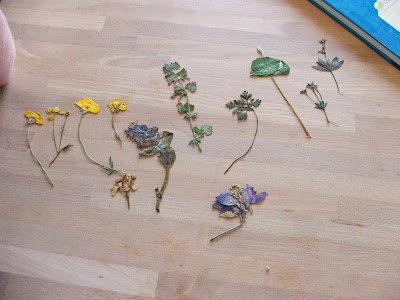
 We picked some flowers and dried them. Jethro really wanted Brett to build a plant press, which he probably would have if he had any tools or materials, but instead we just used a book.

 So, five stars and all that. Go get it if you're interested in helping your kids- and yourself- learn about and enjoy nature.
Book Review for The Kids' Nature Book – 365 Indoor/Outdoor Activities and Experiences (Revised Edition) by Susan Milord
(LINK to it on Amazon)
One early spring day, I was very excited because enough snow was gone and the air was just warm enough that the kids and I could go outside and play for a significant amount of time without frozen feet, hands, and noses. When we came back inside I was inspired to buy a book to keep us outdoors doing interesting things in nature all year. I read reviews for a few different books and ended up with The Kids' Nature Book. I bought a used copy of it through abebooks.com.
I think it is WONDERFUL. I very heartily recommend it. It says for children ages 4 – 10, and my children aged 1-7 have all participated in the activities in it to varying degrees. The book offers ideas of outings, things to observe outdoors, craft projects, simple experiments, games, and suggestions for stories and poems to read. I really can't begin to tell you all of the topics it explores – weather, habitats, flowers, animals, clouds, recycling, beaches, astronomy, insects, plants, adaptations, art supplies from nature, the ocean, pets, Indians, etc.
I really like how it is set up. It has an activity for every day of the year (tied to the seasonal happenings), and each week has a unifying theme like watching birds in flight or exploring in and around water. So I really like that you can pick up the book anytime and go to that day and have a topic offered. That being said, I don't usually follow the suggestions day by day, like a calendar. Usually when we get the urge to do something from the book, we do several of the activities on one day. Of course, you can do things more selectively-- skip around and find topics on whatever suits your fancy.
It has a ton of great ideas, and lots of great information. My son Jethro likes to pick it up and just read it (but then, he always has liked reading non-fiction type books. Weirdo.). Now I've TOLD you it's fun, let me SHOW you.
We gathered frog eggs from a pond to watch their development from eggs to tadpoles to frogs. We have two that are still alive and one of them recently sprouted his back legs. It's really exciting.

 We did some activities about rainbows, like creating a rainbow by filling a glass full of water and placing it on a sunny windowsill.


 Then we bought some colored paper and made a wreath using “Japanese folding techniques.”

 Jethro found an experiment that he thought sounded cool, so he started setting it up (without asking for permission or help) and when Brett saw him getting stuff out and asked him what he was doing, he read about the experiment, also thought it was cool, and helped him finish setting it up. They created stalactites and stalagmites by filling small jars with water and baking soda and tying a weight to each end of a string and placing the ends in the jar. These are not the greatest pictures, but I think you can see that we did grow some stalactites.
 One day without really intending to do an activity from the book, I happened to see a fiddlehead of a fern – something I had seen and read about in the book, so I took a picture of it. The same day, Jethro came home and showed me a fiddlehead he had picked. He told me, “The book says they're eatable, so should we eat it?”
I can't remember if the book suggested a nature notebook or not, but I decided to give the kids a notebook, and Jethro has done some recording in it. Hazel mainly draws pictures and says whether it's a sunny day or rainy day. (I love his picture of eggs, tadpole, developing tadpole, and frog at the bottom.)


 We picked some flowers and dried them. Jethro really wanted Brett to build a plant press, which he probably would have if he had any tools or materials, but instead we just used a book.
 So, five stars and all that. Go get it if you're interested in helping your kids- and yourself- learn about and enjoy nature.
June 9, 2010
My thoughts on Men's Week
(Sorry I haven't posted in awhile. My laptop charger cord died and we were down to one computer. With my husband claiming to need the computer to study every night, I couldn't get a blog in edgewise. The new cord came in the mail today--bless you amazon--so I'm back!)
During Men's Week, several ideas jumped out at me. I wanted to discuss some of those ideas.
1) From J.: ". . . the love of reading is KEY to individuality in learning and understanding." I thought this was an interesting idea because homeschoolers often talk about individualizing, or personalizing, education for each child as a positive of homeschooling. I would argue, however, that a child who is taught to love to read will naturally love to learn and will always personalize their education. For example, how many of you ever read a novel during a science class? There you go--you were personalizing your own education. (I had a science teacher that would ask me what I was reading at the beginning of every class and when I bawled the whole hour while reading Goodbye, Mickey Mouse he only mocked me a little bit.)
I'm not trying to take away from a homeschooling parent's ability to personalize, I'm just saying the all children who love to read personalize their education. Some kids know a whole lot about Sacketts, and others about elves, and others about murder mysteries. I knew a lot about historical fiction. And dragons. I love me a good dragon book.
As a reader and long time self-educator, I know how to find information in a book. So while homeschoolers want to contend that they corner the market on personalized education, it isn't quite true. Reading is the key to an individualized education--as J. pointed out.
2) Also from J., writing about his wife Julia: ". . . and I have enjoyed watching her grow through being challenged socially, politically, scientifically, and mathematically herself." When I read that, all I could think was, oh my, I bet she hasn't always enjoyed being stretched in all those areas. Being a homeschool mom is, well, its hard. It changes us. And change is most often hard.
3) Nick mentioned the time wasting that takes place in school. As a former public school teacher I just want to add an emphatic amen. Don't get me started on announcements.
4) Brett talked about the differences between primary school in Switzerland and the States. There, his second grader comes home at noon. Wouldn't that be awesome--half day second grade? Brett said something important: ". . . and do well academically despite not working like slaves as primary schoolers." I noticed this when we moved from Canada to the States--that elementary school here is so intense. Homework in elementary school?? Crazy.
Many people think that they need to push their children while their children are young and their "sponge-like brains" are absorbing everything. I would argue the opposite. Let your children be little. Let them run and play. They are absorbing everything but the important stuff, like how to be a nice brother and what is heaven, isn't happening during school time. One of my main educational beliefs is that formal schooling shouldn't start until age 8. I don't know if I will put my daughter back into school when she's 8 like I orginally planned, but I do know that the "school" we do now I consider practice for grade 2, and a way to keep my kids out of trouble.
5) Lastly, a few thoughts from my dad that I wanted to discuss. First: "To sum up this lengthy treatise, parents need to provide an educationally rich home environment, instill in their children a belief in the importance of learning and the value of an education, and to teach their children to take responsibility for their own learning."
I thought it was ironic and yet made perfect sense that a die-hard public school supporter would essentially say the same thing that homeschoolers are so fond of saying--teach your children to take responsibility for their own learning. This plays out in a variety of ways. For me and my siblings it meant hearing the inevitable, "Figure it out yourself, I already did my homework," response from my dad if we were desperate enough to ask him for help with homework. Don't ask me how this resulted in children who excelled in school, but it did.
I did well in school because I wanted to go to college and I wanted a scholarship. It wasn't about pleasing my parents. I also wanted to learn. How could I not, with two parents who loved to read, surrounded us with good literature, talked about what we were learning, and continued to learn themselves. It really is about the educationally rich home environment, and belief system that honors education, and giving the responsibility to the children.
My dad also said, "This would be great because the K-12 curriculum is a very small part of what a child should be learning, and, in fact, aside from basic literacy skills, it is probably less important than many other things that parents could and should be teaching their children if they had the time." Another important reminder that school learning is great, but not the most important part of our life-long education.
During Men's Week, several ideas jumped out at me. I wanted to discuss some of those ideas.
1) From J.: ". . . the love of reading is KEY to individuality in learning and understanding." I thought this was an interesting idea because homeschoolers often talk about individualizing, or personalizing, education for each child as a positive of homeschooling. I would argue, however, that a child who is taught to love to read will naturally love to learn and will always personalize their education. For example, how many of you ever read a novel during a science class? There you go--you were personalizing your own education. (I had a science teacher that would ask me what I was reading at the beginning of every class and when I bawled the whole hour while reading Goodbye, Mickey Mouse he only mocked me a little bit.)
I'm not trying to take away from a homeschooling parent's ability to personalize, I'm just saying the all children who love to read personalize their education. Some kids know a whole lot about Sacketts, and others about elves, and others about murder mysteries. I knew a lot about historical fiction. And dragons. I love me a good dragon book.
As a reader and long time self-educator, I know how to find information in a book. So while homeschoolers want to contend that they corner the market on personalized education, it isn't quite true. Reading is the key to an individualized education--as J. pointed out.
2) Also from J., writing about his wife Julia: ". . . and I have enjoyed watching her grow through being challenged socially, politically, scientifically, and mathematically herself." When I read that, all I could think was, oh my, I bet she hasn't always enjoyed being stretched in all those areas. Being a homeschool mom is, well, its hard. It changes us. And change is most often hard.
3) Nick mentioned the time wasting that takes place in school. As a former public school teacher I just want to add an emphatic amen. Don't get me started on announcements.
4) Brett talked about the differences between primary school in Switzerland and the States. There, his second grader comes home at noon. Wouldn't that be awesome--half day second grade? Brett said something important: ". . . and do well academically despite not working like slaves as primary schoolers." I noticed this when we moved from Canada to the States--that elementary school here is so intense. Homework in elementary school?? Crazy.
Many people think that they need to push their children while their children are young and their "sponge-like brains" are absorbing everything. I would argue the opposite. Let your children be little. Let them run and play. They are absorbing everything but the important stuff, like how to be a nice brother and what is heaven, isn't happening during school time. One of my main educational beliefs is that formal schooling shouldn't start until age 8. I don't know if I will put my daughter back into school when she's 8 like I orginally planned, but I do know that the "school" we do now I consider practice for grade 2, and a way to keep my kids out of trouble.
5) Lastly, a few thoughts from my dad that I wanted to discuss. First: "To sum up this lengthy treatise, parents need to provide an educationally rich home environment, instill in their children a belief in the importance of learning and the value of an education, and to teach their children to take responsibility for their own learning."
I thought it was ironic and yet made perfect sense that a die-hard public school supporter would essentially say the same thing that homeschoolers are so fond of saying--teach your children to take responsibility for their own learning. This plays out in a variety of ways. For me and my siblings it meant hearing the inevitable, "Figure it out yourself, I already did my homework," response from my dad if we were desperate enough to ask him for help with homework. Don't ask me how this resulted in children who excelled in school, but it did.
I did well in school because I wanted to go to college and I wanted a scholarship. It wasn't about pleasing my parents. I also wanted to learn. How could I not, with two parents who loved to read, surrounded us with good literature, talked about what we were learning, and continued to learn themselves. It really is about the educationally rich home environment, and belief system that honors education, and giving the responsibility to the children.
My dad also said, "This would be great because the K-12 curriculum is a very small part of what a child should be learning, and, in fact, aside from basic literacy skills, it is probably less important than many other things that parents could and should be teaching their children if they had the time." Another important reminder that school learning is great, but not the most important part of our life-long education.
June 4, 2010
MEN'S WEEK PERSPECTIVES
Our last guest blogger for Men's Week is my hubby, Timothy. He works as an accountant and studies computer programming. Since you already know all about my family, and that we've been homeschooling for two years, I won't go into it. Take it away, Timothy!
Some Pros of Homeschooling:
- The child isn’t subjected to the adverse social influences commonly found in public schools, such as:
Pressure to rebel against and/or express disrespect towards authority
Pressure to explore and express their sexuality in unhealthy ways
Pressure to experiment with substance abuse - Hypothetically speaking, the child receives more attention from his teacher, which has the potential, hypothetically speaking, to make the teacher more aware of the child’s needs as a student.
- Since the child spends more time in the home, with his parents, than he otherwise would if he were attending public school, this gives the parent more opportunities to bond with and nurture the child.
- Lower child-teacher ratio creates more opportunity for the teacher to tailor the curriculum and adjust the pace of teaching to the student’s needs.
Some Cons of Homeschooling:
The child isn’t subjected to the adverse social influences commonly found in public schools. (See above.) Lack of exposure to these influences may hinder the development of the child’s ability to resist them.- The care-taking parent doesn’t get as much alone time away from the child. This could create stress that might otherwise be avoided by sending the child away to school for a few hours each day.
- The child will not achieve the kind of understanding of social norms and mores that, as I see it, can only be gotten through interaction with his peers in an organic social setting.
- The homeschooling family becomes stigmatized and branded by others as weirdos.
- Sooner or later the child will need be capable of succeeding in a traditional educational atmosphere, for example, when he goes to college. The homeschooling environment might not adequately prepare him for this.
June 3, 2010
MEN'S WEEK PERSPECTIVES
Today's guest post was written by J. Hathaway, the husband of one of my dearest friends. They've been homeschooling for about five years now and in the beginning, J. wasn't sure about homeschooling. It has been interesting to see his ideas and feelings toward homeschool evolve. J. is a statistician with five children. I don't know all their ages but the oldest is 10 and the youngest is 2. Take it away, J.!
1) How have your views of education changed because of your wife's views of education?
I don't think I had any views of education before I met my wife, other than "understanding math is power." But the clearest viewpoint I have learned from her is that the love of reading is KEY to individuality in learning and understanding.
2) Do you think homeschoolers are quacks--or, in other words--what changed your mind about homeschooling and how do you feel about it now?
YES, I still think homeschoolers are quacks, in general. But I have found that the number of quacks among "normal" schoolers is also high. Meaning, all groups have quacks among them. What is typically implied with "quacky homeschoolers" is their poor social skills and I don't think that's a function of being homeschooled. It goes back to the relationship between causation and correlation. I don't think that homeschooling causes "quackiness," I think that quackiness in children is caused by their parents and quacky parents choose to homeschool at a higher rate. Therefore, quackiness is correlated with homeschooling but not caused by homeschooling. My views on homeschoolers changed when I realized that the rate of quackiness wasn't much different among homeschoolers as compared to public schooled children. This idea together with the fact that homeschoolers can choose who their kids interact with allows more ability to avoid quacky people. Another thing I like about homeschooling deals with the primary parent teacher. My wife is a stay-at-home mom, the primary parent teacher, and I have enjoyed watching her grow through being challenged socially, politically, scientifically, and mathematically herself (www.directionliving.blogspot.com).
3) What do you want for your children or, in other words, what do you think being an educated person entails?
First, I want my children to be able to read, understand, and present information clearly. Second, I want my children to not be afraid of math!!! Third, I want my children to be fascinated with current economic, political and scientific thought. These three ordered points assume a foundation in religious faith.
4) What positives have come for your family from the decision to homeschool?
In no specific order, here are some positives:
Positive #1: We can do whatever we want, whenever we want to . . . literally! We wake up when we want to. We go to bed when we want to. And we go on vacation when we want to.
Positive #2: My family depends on each other for activity and friendship. And we as parents are obviously more involved in the learning of our children.
Positive #3: Due to new public school programs here in WA, we get some tax dollars back. :-)
Positive #4: My children don't have potty mouths! Nor do they know how to make obscene gestures . . . except for those which I taught them myself! :-)
1) How have your views of education changed because of your wife's views of education?
I don't think I had any views of education before I met my wife, other than "understanding math is power." But the clearest viewpoint I have learned from her is that the love of reading is KEY to individuality in learning and understanding.
2) Do you think homeschoolers are quacks--or, in other words--what changed your mind about homeschooling and how do you feel about it now?
YES, I still think homeschoolers are quacks, in general. But I have found that the number of quacks among "normal" schoolers is also high. Meaning, all groups have quacks among them. What is typically implied with "quacky homeschoolers" is their poor social skills and I don't think that's a function of being homeschooled. It goes back to the relationship between causation and correlation. I don't think that homeschooling causes "quackiness," I think that quackiness in children is caused by their parents and quacky parents choose to homeschool at a higher rate. Therefore, quackiness is correlated with homeschooling but not caused by homeschooling. My views on homeschoolers changed when I realized that the rate of quackiness wasn't much different among homeschoolers as compared to public schooled children. This idea together with the fact that homeschoolers can choose who their kids interact with allows more ability to avoid quacky people. Another thing I like about homeschooling deals with the primary parent teacher. My wife is a stay-at-home mom, the primary parent teacher, and I have enjoyed watching her grow through being challenged socially, politically, scientifically, and mathematically herself (www.directionliving.blogspot.com).
3) What do you want for your children or, in other words, what do you think being an educated person entails?
First, I want my children to be able to read, understand, and present information clearly. Second, I want my children to not be afraid of math!!! Third, I want my children to be fascinated with current economic, political and scientific thought. These three ordered points assume a foundation in religious faith.
4) What positives have come for your family from the decision to homeschool?
In no specific order, here are some positives:
Positive #1: We can do whatever we want, whenever we want to . . . literally! We wake up when we want to. We go to bed when we want to. And we go on vacation when we want to.
Positive #2: My family depends on each other for activity and friendship. And we as parents are obviously more involved in the learning of our children.
Positive #3: Due to new public school programs here in WA, we get some tax dollars back. :-)
Positive #4: My children don't have potty mouths! Nor do they know how to make obscene gestures . . . except for those which I taught them myself! :-)
June 2, 2010
MEN'S WEEK PERSPECTIVES
Today's guest poster is Nick Brown, a resident and native of California who teaches history at a public high school. A public high school with a unique set of issues. Nick has two children, ages 5 and 3. He and his wife, Becky (yes, she's guest posted here before), are jumping into homeschooling next year. Here are some of his thoughts on why they are headed in that direction. Take it away, Nick! Okay, take it away Becky--she wanted her own preface included.
I need to preface: my husband is a pretty quiet, pretty mellow type of guy. And other than a few instances where he said he felt really strongly about me homeschooling the kids, he’s pretty much left the decision up to me and what I’m willing and able to do. All of this being said, when I read the following, I was a bit shocked by the vehemence. And then I realized he had just been through some very tense negotiations with his administration and had lost – to the ultimate benefit of a superintendent’s resume and the detriment of the students’ educations, so he’s a little disillusioned a the moment. Also, he had just finished reading around a thousand pages of Ayn Rand – which can be a bit overwhelming as well. So, here’s a peek inside my husband’s head. It’s surprising to say the least.
Earlier this year I came across the following passage as I was reading one of the great novels of the twentieth century: Atlas Shrugged.
“He thought of all the living species that train their young in the art of survival, the cats who teach their kittens to hunt, the birds who spend such strident efforts on teaching their fledglings to fly - yet man, whose tool of survival is the mind, does not merely fail to teach a child to think, but devotes the child's education to the purpose of destroying his brain, of convincing him that thought is futile and evil, before he has started to think ... Men would shudder, he thought, if they saw a mother bird plucking the feathers from the wings of her young, then pushing him out of the nest to struggle for survival - yet that was what they did to their children.”
"Somewhere, he thought, there was this boy’s mother, who had trembled with protective concern over his groping steps, while teaching him to walk, who had measured his baby formulas with a jeweler’s caution, who had obeyed with a zealot’s fervor the latest words of science on his diet and hygiene, protecting his unhardened body from germs – then had sent him to be turned into a tortured neurotic by the men who taught him that he had no mind and must never attempt to think."
I need to preface: my husband is a pretty quiet, pretty mellow type of guy. And other than a few instances where he said he felt really strongly about me homeschooling the kids, he’s pretty much left the decision up to me and what I’m willing and able to do. All of this being said, when I read the following, I was a bit shocked by the vehemence. And then I realized he had just been through some very tense negotiations with his administration and had lost – to the ultimate benefit of a superintendent’s resume and the detriment of the students’ educations, so he’s a little disillusioned a the moment. Also, he had just finished reading around a thousand pages of Ayn Rand – which can be a bit overwhelming as well. So, here’s a peek inside my husband’s head. It’s surprising to say the least.
Earlier this year I came across the following passage as I was reading one of the great novels of the twentieth century: Atlas Shrugged.
“He thought of all the living species that train their young in the art of survival, the cats who teach their kittens to hunt, the birds who spend such strident efforts on teaching their fledglings to fly - yet man, whose tool of survival is the mind, does not merely fail to teach a child to think, but devotes the child's education to the purpose of destroying his brain, of convincing him that thought is futile and evil, before he has started to think ... Men would shudder, he thought, if they saw a mother bird plucking the feathers from the wings of her young, then pushing him out of the nest to struggle for survival - yet that was what they did to their children.”
I immediately thought of my own children and couldn’t stomach the thought of these two little shining stars, sitting in a classroom filled with kids whose parents have not one single moral in common with me. How can I justify sending my kids to a place where they will waste 75% of their time, be exposed to wrong ideas and profanity, risk political indoctrination, and possibly violence?
I work in a public school, so I know that there is a dumbing-down that occurs; the CST has become so important that it drives curriculum, to the exclusion of other important materials. Those tests were written by bureaucrats with a certain political agenda that I don’t necessarily agree with. I know how much time is wasted on classroom management, mandated programs with little to no efficacy, waiting for the SDC, RSP, ELD students to catch up to the rest of the class, girls putting on makeup, boys posturing for attention, texting.
I want more for mine and I expect more for mine. Everyone should, but everyone doesn’t, so we’re left with the current failing system. And I don’t want to participate in it. Another of Rand’s paragraphs kind of sums it up for me:
I work in a public school, so I know that there is a dumbing-down that occurs; the CST has become so important that it drives curriculum, to the exclusion of other important materials. Those tests were written by bureaucrats with a certain political agenda that I don’t necessarily agree with. I know how much time is wasted on classroom management, mandated programs with little to no efficacy, waiting for the SDC, RSP, ELD students to catch up to the rest of the class, girls putting on makeup, boys posturing for attention, texting.
I want more for mine and I expect more for mine. Everyone should, but everyone doesn’t, so we’re left with the current failing system. And I don’t want to participate in it. Another of Rand’s paragraphs kind of sums it up for me:
"Somewhere, he thought, there was this boy’s mother, who had trembled with protective concern over his groping steps, while teaching him to walk, who had measured his baby formulas with a jeweler’s caution, who had obeyed with a zealot’s fervor the latest words of science on his diet and hygiene, protecting his unhardened body from germs – then had sent him to be turned into a tortured neurotic by the men who taught him that he had no mind and must never attempt to think."
June 1, 2010
MEN'S WEEK PERSPECTIVES
Today's guest poster is my brother-in-law, Brett Bell. I asked Brett to participate because he just moved his family to Switzerland and I wanted to see how he felt about the disparity between our school system and the Swiss school system. Brett has four children ages 7, 5, 3, and 1. Brett is currently working on a post-doc at the University of Bern in something to do with biomedical engineering. I think in robotics, but don't quote me. This particular post is in question/answer format. Take it away, Brett!
1) How have your views of education changed because of your wife's views of education?
I have learned a love of reading from my wife. Before marriage, I read for leisure, but only seldom. Her love of reading rubbed off on me and I immediately began reading many classic works by Dumas and Dickens and so forth. I really felt like I had been missing out on some great knowledge and I needed to catch up.
2) Do you feel your children are getting a quality education in public school?
Being in Switzerland has definitely opened my eyes on this subject. I can only speak on the merits/demerits of primary school as that has been our experience. There are several aspects of secondary school which do not appeal to me (from what I’ve heard).
Anyhow, in Switzerland, 1st grade does not begin until 7 years of age, and then they still only go half a day. I guess they think that kids should spend more time at home with their mothers. This has positive and negative effects. If the weather is nice, Kayli might take the kids out in the afternoon to the frog pond or a walk in the woods or such. But, if the weather is poor and they are stuck indoors, they get restless and you can tell that they aren’t the angels that they normally are.
The second point is that they focus much more on hand work here than in the States. Printing, cursive, artwork, crafts, etc. are very much the focus. They also talk a lot about the environment and our role in it. Jethro has even had woodworking. They go on field trips to the farm, to the woods on a biweekly basis. The point is, they do a lot of hands on things.
Finally, the main point- they are every bit as smart as Americans and do well in academics in spite of not working like slaves as primary schoolers. Again, I don’t know if they have to work extra hard later to catch up, but I doubt it. This has made me realize that learning outside of the classroom is just as important for kids as what is taught inside the classroom.
3) Do you think homeschoolers are quacks?
I think homeschoolers, baseball dads, and musicians are all quacks. No, seriously, anything can get out of hand if it is not done in moderation and with the right attitude/goals. Homeschooling can be fine and I’m sure that kids learn a lot of what you think is important. The trouble with that however, is that what one homeschooler thinks is important may be and probably is skewed. At least in public school you get exposed to many different things and not just the pet projects of a parent.
4) What do you want for your children or, in other words, what do you think being an educated person entails?
I think educated means being open to new information. No one is ever fully educated, therefore it is a process. I must admit, it is very frustrating for me to encounter and work with people who do not want to learn. Maybe that is because learning has never been difficult for me. In spite of that, I feel that whether someone learns quickly or slowly, we can all learn. It’s the willingness and effort that counts.
So, in short, I want my children to try new things and try to do things that are difficult.
1) How have your views of education changed because of your wife's views of education?
I have learned a love of reading from my wife. Before marriage, I read for leisure, but only seldom. Her love of reading rubbed off on me and I immediately began reading many classic works by Dumas and Dickens and so forth. I really felt like I had been missing out on some great knowledge and I needed to catch up.
2) Do you feel your children are getting a quality education in public school?
Being in Switzerland has definitely opened my eyes on this subject. I can only speak on the merits/demerits of primary school as that has been our experience. There are several aspects of secondary school which do not appeal to me (from what I’ve heard).
Anyhow, in Switzerland, 1st grade does not begin until 7 years of age, and then they still only go half a day. I guess they think that kids should spend more time at home with their mothers. This has positive and negative effects. If the weather is nice, Kayli might take the kids out in the afternoon to the frog pond or a walk in the woods or such. But, if the weather is poor and they are stuck indoors, they get restless and you can tell that they aren’t the angels that they normally are.
The second point is that they focus much more on hand work here than in the States. Printing, cursive, artwork, crafts, etc. are very much the focus. They also talk a lot about the environment and our role in it. Jethro has even had woodworking. They go on field trips to the farm, to the woods on a biweekly basis. The point is, they do a lot of hands on things.
Finally, the main point- they are every bit as smart as Americans and do well in academics in spite of not working like slaves as primary schoolers. Again, I don’t know if they have to work extra hard later to catch up, but I doubt it. This has made me realize that learning outside of the classroom is just as important for kids as what is taught inside the classroom.
3) Do you think homeschoolers are quacks?
I think homeschoolers, baseball dads, and musicians are all quacks. No, seriously, anything can get out of hand if it is not done in moderation and with the right attitude/goals. Homeschooling can be fine and I’m sure that kids learn a lot of what you think is important. The trouble with that however, is that what one homeschooler thinks is important may be and probably is skewed. At least in public school you get exposed to many different things and not just the pet projects of a parent.
4) What do you want for your children or, in other words, what do you think being an educated person entails?
I think educated means being open to new information. No one is ever fully educated, therefore it is a process. I must admit, it is very frustrating for me to encounter and work with people who do not want to learn. Maybe that is because learning has never been difficult for me. In spite of that, I feel that whether someone learns quickly or slowly, we can all learn. It’s the willingness and effort that counts.
So, in short, I want my children to try new things and try to do things that are difficult.
Subscribe to:
Posts (Atom)