Showing posts with label Geography. Show all posts

April 24, 2012

The second day of the school year went better than the first.  It was an "interrupted" day as the children all had dental appointments (the drawback to making appointments 6 months in advance are many) in the morning, but the afternoon we did our first fun history projects/hands-on learning.

In the pics below you can see some of the things we did.  The poster with "Nomadic" and "Agrarian" written on it was to help facilitate a discussion about the pros and cons of nomadic and agrarian lifestyles.  We discussed the two lifestyles and wrote our thoughts on the poster.  My kids usually do better with a "visual."  

On the poster you'll notice my hubby's bartering lesson.  He set it up with 6 labor specialties as 6 kids were participating.  Each envelope held the resources for one specialty.  The food producers had more resources than the others because we thought the brick mason and thatcher might charge more than one loaf of bread for their services.  They did not.  If they had been older, it probably would have occurred to them.


The goal was for each child to get the materials needed for a complete house, a goat for milk, wheat to feed the goat, and a loaf of bread to feed the people.  Each child had to barter with every other child to get all the things he/she needed.  It went really well--in a chaotic help-the-three-year-old-who-isn't-getting-this-but-is-still-having-a-good-time kind of way.

I highly recommend doing something like this if you are trying to teach the concept of division of labor.  If you are strictly trying to help your kids figure out what the word "barter" means, I recommend having a good old-fashioned trading session.  My family started doing this after I moved out, and recently they became nostalgic for it so they planned a trading session with all of us that live in the area (which translated to 20-odd grandkids plus all the adults).

It was hilarious.  My son traded Grandpa a pack of gum for a bow (as in bow and arrow).  My other son started out with pretty much nothing and wound up with a book and some trilobites to grow.  My one daughter only wanted the gigantic pixie stick Uncle Wyatt brought, and she got it.  She could scarcely contain her agony that another person might out-barter her.

This works as a casual family activity or homeschool lesson.  Everyone grab all the stuff you don't want and trade it!


My two oldest daughters, Miriam (8--almost 9) and Emeline (5).  Emeline officially started kindergarten this year.  Yeah!  Can we all consider this their first day of school pictures?  Yes?  No??  No???  Thanks a lot. 
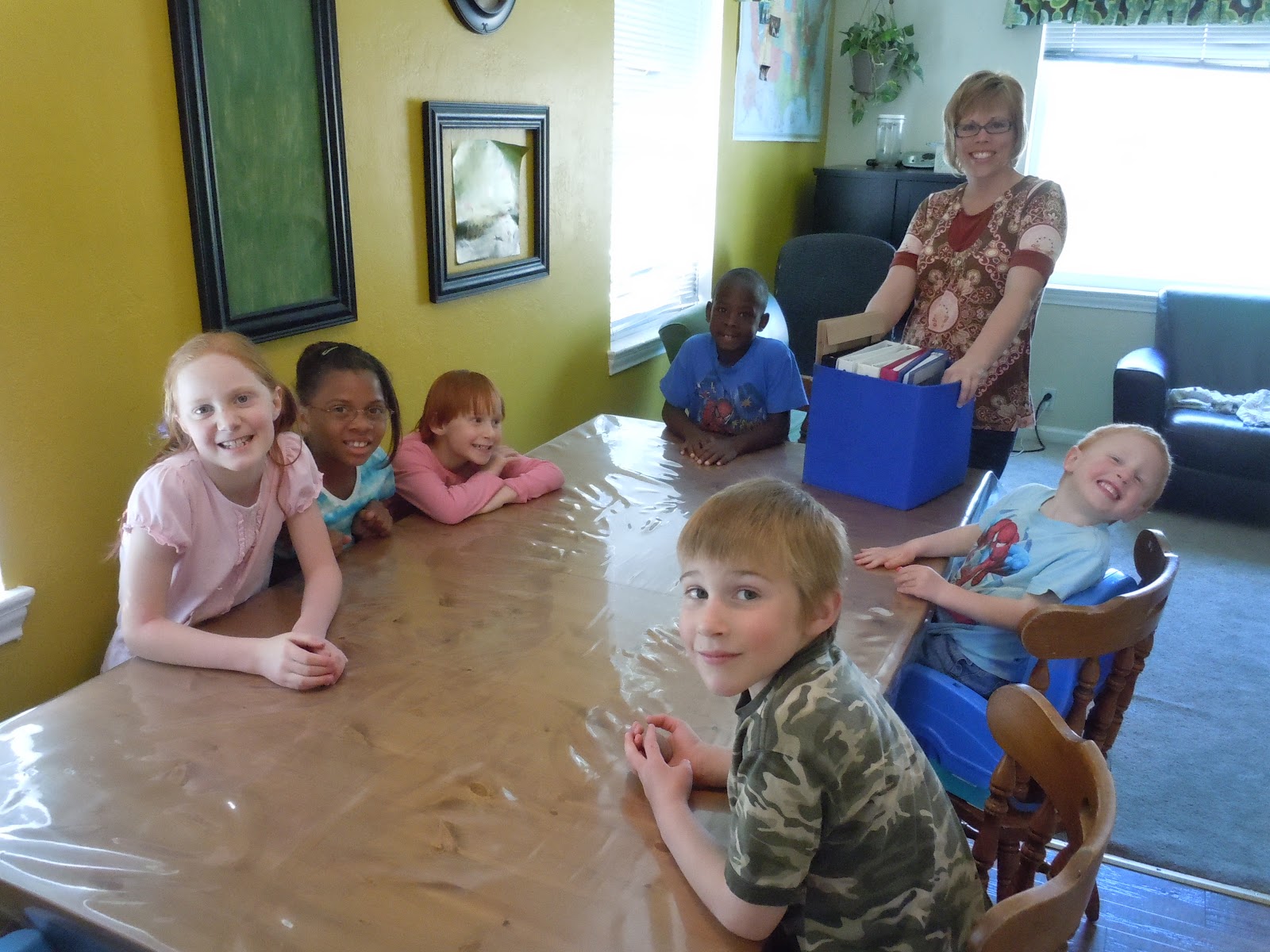
The Ancient Historians.  Miriam, Ahnika, Emeline, Ty, Aunt Julie (she's actually my hubby's aunt, but my kids don't realize this), Eli, and Cowen.  Eli should, technically, have been taking a nap right then, but he so wanted in on the action that I let him stay up.  Then he fell asleep on the couch at 5:00.  Then he didn't go to sleep tonight until 9:30.  Grr.
Below you'll notice Miriam with her salt map of the Fertile Crescent.  The desert on the left, the Euphrates and Tigris Rivers down the center, and the Zagros Mountains on the far right.  Pretty snazzy.
Some students had a more . . . fluid . . . interpretation of the point of the activity and the geographical landmarks of the Fertile Crescent.  Julie and I are totally okay with fluid interpretations among the younger crowd.
Julie provided my kids with a Century Book.  I know this is a pretty common thing in the homeschooling community so it probably doesn't need to be referenced anymore, but I still feel bad that I don't know exactly where this idea originated.  Suffice it to say--it did not originate with me or Julie.  Charlotte Mason, maybe??

Since I am so very unlearned about ancient history (yes, I have an MA in history--no, I did not study anything but American history and that was pretty much limited to WWII and masculinity) I thought a Century Book would be a helpful way for me to "see" what was happening when and where.

On the front page of each piece of paper is a 100 year chunk of time--hence the term, Century Book.  On the back of each sheet of paper are 6 boxes--one for each area of the world we are studying throughout the year.  We're approaching our study geographically, rather than chronologically, so I'm hoping that filling in the boxes will help the kids see what was happening at the same time all over the world.

Miriam decided to use her barter house to show the shift from nomadic to agrarian living.  Clever girl.  The grid under the house is her fields--some rows are newly planted so you can see the seeds, other rows are blue because they are being irrigated.  The pink row I believe is beets and they are ready to be harvested.  Nice.

And that ends the Second Day.

April 7, 2011

Audio Books

A few weeks ago, I traveled to Provo with my kiddos to hang with my sister and her kiddos. It is a good 90 minute drive or more. When thinking about the drive, I realized that I would go bonkers if I had to listen to 50 Silly Songs for Kids one more time. Usually I don't mind, but lately, man it has been annoying. We'll blame it on hormones. (If they would only choose Newsies every once in awhile, or our Disney collection--or anything but "the smile was on the crocodile" etc.)

Then I had a brain-wave. The reason my children were listening to silly songs instead of the classical station is because my hubby gave me a new cd player for the van. We could now participate in one of my favorite activities--listening to an audio book.

So I went to the library and got one of my favorite books, hoping the reader would do a good job. He did!!! He really, really did. Graeme Malcolm, whoever you are, you ROCK at reading books.

Those of you who listen to audio books know that a reader can make or break the book.

The Tale of Despereaux by Kate DiCamillo (a GOLD STAR book for sure) was read brilliantly. The drive was over before my children realized they should be annoyed by the length of it. When we returned home, my children insisted we take the cds inside so they could finish the story immediately. They loved it.

So will you. If you don't have time to listen to it (I don't listen to books on tape much now that I don't commute), please read it. Great book for ages 4 on up (at least, my four year old loved it).


While we are on the subject of audio books, I must HIGHLY RECOMMEND my very favorite audio books.

The Mrs. Pollifax series by Dorothy Gilman.

These are available in written form, but if at all possible, do not read these books. Listen to them. The reader, a Barbara Rosenblat, is without a doubt the best reader I've ever heard--and I listened to A LOT of books on tape during my year commuting.


My very favorite of the series is the second one, The Amazing Mrs. Pollifax. Mrs. Pollifax, if you've never heard of her, is an elderly widow who is bored with life. She feels useless. Her two children are raised and gone and all Mrs. Pollifax does is grow flowers and meet with her garden club. So, one day, she decides to go to the headquarters of the CIA and offer her assistance.

Because of a few odd circumstances, she winds up with a job. One that is supposed to be easy and danger-free and is, of course, quite the opposite.

The second book covers her second assignment and it is hilarious and wonderful. A small disclaimer, one of the characters in the second book says, "What the hell," all the time. So if you are opposed to that, you might want to skip the second book. There is no language in any of the other books that I can remember. Normally I don't approve of swearing, but something about the Hungarian accent made it really, really funny to me. Sorry if your opinion of me has now diminished. ;)

If you assign these books to your children (I would say 10 and up would enjoy them although they are aimed at adults), use them for fun or in conjunction with geography. Each book has Mrs. Pollifax flying off to another exotic location for another "non-dangerous" mission that becomes very dangerous very quickly. Off the top of my head I remember a book set in South America, the Middle East, Hungary, China, Africa. Okay, that was vague, but it was off the top of my head.

And if you have a trip to go on in the near future, please, please, please get the first or second Pollifax book on tape. You will be highly entertained and will not regret it.

March 12, 2011

Cooking the South African Way

My children really enjoyed Festivals of the World: South Africa. It had a list of all the festivals in the area, and it sure seemed like all people do in South Africa is party. The kids and I decided we wanted to move there!

After reading the book we watched a few youtube videos--some about the game of cricket as that came up in the book and my kids had no clue there was a sport named after an insect. :) We also listened to both of South Africa's national anthems. After that I couldn't resist playing them the most beautiful national anthem in the world--O Canada. Yes, I am Canadian. Why do you ask?

After all the youtube videos, we were hungry, so I told the kids they could make pumpkin fritters from the recipe found in this book: Cooking the Southern African Way by Kari Cornell. Since I had to nurse Harriet right after I told them they could cook, they proceeded without me. It actually, surprisingly, worked better that way. It is hard to be too uptight when you don't see most of the mess until clean up time.

Besides, they did an awesome job.

Miriam's reading the cookbook that it sitting on the chair. After Cowen opened the can of pumpkin and orange stuff started flying, I ordered the library book moved to a more secure location.


I did the frying for safety reasons. I used more oil than necessary as I realized early on that the smaller the fritter, the better. Pumpkin doesn't set up like we're used to with more flour heavy projects. Therefore, to get the best crispy outside to mushy inside ratio, we made the fritters pretty small.

Nothing like a little cinnamon and sugar to help the pumpkin go down.
We all really liked them, and I'm not a huge pumpkin fan. The mushyish center threw us off at first--very different from a corn fritter or scone--but it really was tasty and you could tell it was cooked properly, just a different texture than we were used to.
The next morning I used the remaining pumpkin in my pancakes. You can't taste the pumpkin very much and it is an extra veggie. Brilliant. Besides, kids like it because the pancakes are orange.
If you're feeling like a South African treat--a pumpkin fritter is a pretty good option.

PS--I've joined the throng of "spinach smoothie" weirdos. You really can't taste the spinach. I never would have believed it if I hadn't tried it. I make my own yogurt for our smoothies to cut down on sugar (then I add 4 TBLS back in--go figure), add some frozen berries, a bunch of spinach, and voila--a lovely addition to lunch or a nice snack. Homemade yogurt is yummy and super easy and way cheaper. You should try it.

March 4, 2011

Maps

I was going to do a whole sub-unit on explorers during the Africa segment of the Babies Unit. First we read about the explorer Mary Kingsley. Then, we read through (skipping when it became too much info) Exploring the World: Da Gama, Vasco da Gama Sails Around the Cape of Good Hope by Robin S. Doak.

It is a really good book. The maps are very useful and the pictures are interesting. It is designed for middle readers so there were a few places where we bogged down. Certainly not the fault of the book--just the ages of my children. Then I pulled out an outline map that included Europe and Africa and had the kids add a line for da Gama's trip, with dots at all the places in Africa that he stopped.

It is the first time we've done a map to demonstrate something besides the location of places. It was fun, we enjoyed it, and I forgot to take pictures.

So that was all pre-Harriet. After Harriet, I thought I would jump back into things to help my kids stay happy and not bored.

Ha.

I didn't jump back into anything except exhaustion. Baby wakes up at 11:00 pm, 2:00 am, and 5:30 am (or 6:00 am--sometimes even a little later than that), so I cannot complain about her sleeping habits. She's an angel for a two-week old.

However, I'm still exhausted.

So rather than read Exploration Through the Ages: The Travels of Livingstone by Richard Humble to all my children and do a similar map of his travels, I just had Miriam read the book to herself and we chatted about it. I read the book (as did my hubby--we both enjoyed it) first so I could guide the discussion to exploration and what was cool about it and what would be hard about it and what the Africans probably thought about these white foreigners telling them to change their lives and become Christian. This leads into a discussion of our missionaries and why we tell people they should change their lives. Good stuff.

I definitely recommend this book for any studies on Africa, missionary work, exploration, or colonialism. It is a great read.

Dr. Livingstone, I presume.

March 2, 2011

Last Day Spent on Babies

Not much has been done by way of school around here. However, a baby in the house is a daily lesson. Since baby was here, I decided to read the last two baby books I'd checked out of the library and give a short lecture about being careful with the baby.

Hello Benny! by Robie H. Harris was a huge hit with all four of my older children. It discussed in pretty good detail what a baby needs and what it is like to be a baby. For example, one of our favorite pages discusses what a baby can see and then has two images of Benny's dad--one close-up and clear and one farther away and blurry. Great way to drive the point home. In short, I was impressed with this book.


Welcome, Baby: Baby Rhymes for Baby Times by Stephanie Calmenson was a hit with Miriam and Emeline. The rest of us lost interest pretty quick.
There you have it. Two more baby book ideas if you are interested in teaching your kids about babies.

February 11, 2011

Africa/Namibia: Day Three

Day Three was about African culture. Not its now culture so much as its more ancient culture that still exists in various forms today.

We started by reading a book called Talking Drums of Africa by Christine Price. The book was so boring I was secretly hoping Miriam would complain and give me an excuse to stop reading it. She didn't. None of them did. So we read the whole boring thing. I don't recommend it, except that it did have some really interesting information about African drums. For example, in the pic below is a "talking drum." The drummer pulls on the strings to tighten and loosen the drumhead to raise and lower the pitch of the drum so it sounds like African languages that are based on pitch. Cool! So, it might be a good idea to scan this book as drums go with Africa like baseball goes with the USA.

Besides, after reading the book, you get to watch youtube videos of African drummers and dancers--and that is awesome!


As a sidenote, this past summer our library put on a series of free activities. One of those activities was an African dancer and drummer. Neither of the people were actually from Africa but both had lived and studied there and both were awesome!!! The dancer, Deja Mitchall, had everyone get up and try it and I did and I loved it. Loved it. Loved it enough that I made learning African dance one of my life goals. I kept her card to remind myself of this life goal. She teaches African dancing at the Eccles Art Center in Ogden, Utah. When my children are a wee bit older, I plan on taking a few of her classes.

If you are studying Africa and live along the Wasatch Front and want to know where you can see some actual African dancing and hear live African drumming, she'd be a good go-to person. Remember, I'm in the lazy end-of-pregnancy mode, or I'd have contacted her and set up a field trip myself.

Here's her info according to her business card. Deja Mitchell: Dancer/Choreographer/Teacher African and Modern Dance. Weekly classes, workshops, Performances. 801-458-6335, tribalovedancer@hotmail.com.

If you look her up on google you'll find her website, which has some great pics of her trips to Africa and the dancing she did there. Also, she puts on a few workshops every summer at the Egyptian Theater for kids wanting to learn African dance. I fully intend to put Miriam in one when she's nine or ten--hopefully Deja will still be around then.
After watching youtube for a long time, we returned to the couch and flipped through the DK Eyewitness Book: Africa by Yvonne Ayo. Great pics. We focused on the various art work more than anything else. My son, of course, wanted to focus on the weapons so we spent some time with those as well.

I made sure I pointed out pictures of carved gourds like the one in the pic below. They are cool.

After we looked through the book, I pulled out some clay and some skewers and had the kids practice carving. Granted, clay carving with skewers is not as cool as cleaning out a gourd, drying it somehow, then carving it and dying it--but my kids still seemed to like it!

I carved for awhile, then worked on supper. My kids spent the rest of the afternoon carving and creating with the clay. The DK book proved inspirational for my kids in ways I hadn't anticipated (they copied statues and weapons and houses, etc.). In the end, I wished I had given them play-dough for the activity as the clay stuck on my rolling pin and cookie cutters much worse than play-dough. Grr.

Good times, though.

As a side-note: in my previous post I mentioned that reading plants ideas in children's brains that they later use to make connections. I have an example. (Yes, I am sort of bragging about how smart my son is, but mostly I'm reiterating the fact that READING IS CRITICAL to expose your children to lots of ideas that they can use to connect other information. I'm an English teacher--I can't help myself.)

While we were looking at the DK book, we turned to a page that had a Zulu shield like the one pictured below.
Without saying anything, my son (5 yrs old) leaped off the couch and went racing downstairs. Miriam and I looked at each other with our eyebrows raised then went back to looking at the pictures.

A few minutes later Cowen came back upstairs with an old Childcraft book with a collection of stories in it about battles. One of the battles, you guessed it, involved the Zulu people and the British. Cowen has never read the story because he doesn't read that well yet, but he has studied that book over and over because it is all about fighting and has lots of pics of weapons. He recognized the shield and knew that the battle must be about an African tribe--so he ran off to find it to have me read it to him.

Amazing connection. Amazing memory.

Thanks again, Mom, for giving me the Childcraft books when all your children wanted them. To all my readers: if you ever see any Childcraft books (you know the ones--they look like encyclopedia's almost, each hardbound book about a different subject) buy them. Just do it. They are awesome and keep my children fascinated for hours at a time.

February 9, 2011

Africa/Namibia: Day Two

Day Two was actually a night and the next morning. I wanted to prep my kids for their field trip, so we read a book called Namibia by DE Gould. It was way too long and detailed to read in its entirety to my children, but it was the only book the library had specifically about Namibia. It worked well enough for my purposes. We looked through all the pictures and talked about them. We saw pictures of members of the Himba tribe (the tribe featured in the Babies documentary). We found Namibia on a map and discussed it being a country that borders the ocean and also contains a lot of desert. Although not perfect, it worked.

Then we read Uncommon Traveler: Mary Kingsley in Africa by Don Brown. We've read this book before and I jumped at the chance to check it out again. We love it. She's one tough cookie. And brave. And awesome. And female. Fantastic. I would even go so far as to call this a GOLD STAR BOOK.

The book didn't have anything to do with our field trip, but I like it and wanted to read it. So I did. My children would have me read it every day, so they didn't complain.

And now the field trip.

On Friday, I drove the kids to Provo for a field trip. First stop was Aunt Kami's house to drop off the two youngest. Then Miriam, Cowen, and I went to BYU's anthropology department where we met up with another homeschool family (the mom of that family graduated with an anthropology degree from BYU and set this whole thing up--thanks Sarah!!) and a certain Dr. Crandall. Dr. Crandall has lived in Namibia and goes there on field studies often. We went to hear what he had to say about it.

Let's just say that I was a little puffed up with pride by the end. Dr. Crandall asked if anyone had questions and Cowen had a great question (do the people carry spears as they travel around?--answer is yes, they carry spears to protect themselves from lion attack). Then Dr. Crandall said his wife had a baby while they lived there and I asked about birthing facilities. He said that the cities are very modern and Miriam said: "Is that because of when the Germans took over?" She remembered that from the Namibia book. I didn't even remember that from the Namibia book. See, reading really does plant things in their brains that they can later use to make connections.

Then Cowen asked about killing elephants and protecting crops and he and Miriam both explained to Dr. Crandall that they knew all about migrating animals in Africa (thank you James Earl Jones). Basically, we had only spent two days on Africa but my kids made connections that surprised me and were able to sound intelligent while talking about it. Love it.

Now if only I could get Miriam to stop the dramatic sighing when she's bored, my kids' behavior would have been perfect. :)
PS--Do you know how strange it is to go to campus now that so many buildings look different??? Besides the fact that returning to campus with children in tow is weird. It is almost like I dreamed the whole four years up--or it was an Alice in Wonderland type of adventure. Sometimes, I feel old. :)

February 8, 2011

Namibia: Day One

I'm afraid there isn't much about Namibia in the library. Africa in general, and African animals in particular, have resources galore. But Namibia--not so much. So, instead of focusing entirely on one country in Africa, I decided to make this section of our Babies Unit a little broader in scope. Continental, in scope, you could say.

Day one was about building interest. As I have come to find out, my children love animals in a deep, passionate way. So, I started with animals. Always build on their interests when possible. But, you pros already knew that.

To start off the day we read a book called: Who Comes to the Water Hole? by Colleen Stanley Bare. I couldn't find a cover image, but do not let that deter you. It was a great book. The pics were not National Geographic quality, but they were plentiful and in color and varied. The book talks about the wet and dry seasons, which was helpful later on that day when that concept came up again.

Then we read Face to Face With Cheetahs by Chris Johns with Elizabeth Carney. GOLD STAR BOOK. I'm pretty sure this is one of the best animal books we have ever read. It is published by National Geographic and Chris Johns is a National Geographic photographer so the pictures were beyond amazing. But the text was excellent as well. It was just enough information. Perfect children's book.

To end the day, we watched the movie Africa: The Serengeti. My daughter realized it was narrated by Simba's dad before I did. Smarty pants. James Earl Jones's voice really added to the overall coolness of the movie. How could it not? This is an IMAX movie, so only 40 minutes long (perfect for small children) and has a few strange cinematography moments probably due to it being a 3D movie. Despite that, the movie was excellent. It showed herds of wildebeests migrating and lions and crocodiles attacking them. Other African animals also make cameo appearances. The kids really caught on to the wet season/dry season concept, but I didn't realize that until later. Overall, this was a very enjoyable movie to watch with the kids and it made Africa really exciting to them.

Later that night, I had my hubs read A Story A Story by Gail E. Haley to the children. I don't usually use nightly story time for school purposes, but there were a few Africa books that didn't tie in very well to the activities I planned, and this is one of them.

It is an awesome book. Especially if you or your hubby do voices. My hubby does. My children were riveted. Highly recommend this one. It won the Caldecott and it deserved to win. Enough said.

So--day one went very well.

February 4, 2011

San Fran: The Golden Gate Bridge

If it weren't for the great book pictured below, I would pretend that I didn't spend a "day" talking about the Golden Gate Bridge. I know you are expecting some great bridge making activity with toothpicks and marshmallows (how do you know how to make a flying buttress, Becky????) or popsicle sticks, or something.

But no. I planned on giving my kids glue and popsicle sticks and seeing what they came up with, but in the end, even that seemed like too much hassle. I'm due in three weeks. Everything seems like too much hassle. (I did get all the baby's clothes/blankets/burp cloths washed and rinsed twice and folded and put away. My kids have very, very sensitive skin. So see--I'm accomplishing things, just not gung-ho homeschool things.)

However, Pop's Bridge was a great book for anyone studying bridges or San Fran and I wanted to make sure you were aware of it--in case any of you do this unit.

Pop's Bridge by Eve Bunting.

To sort of make up for my bridgeless bridge lesson, I give you another San Fran idea. As we all know, Ghirardelli chocolate is made in San Fran. Chocolate interests me. It interests me a great deal. So I thought--we should make something out of San Fran chocolate.

So we did.
I decided to have the kids make a chocolate pudding recipe that I quite like. It is called Silken Chocolate Pudding and I found the recipe in the Moosewood Restaurant Recipe Book (not exact title). It is a vegetarian restaurant. No, I'm not a vegetarian, but I've found that vegetarian cookbooks often have some killer pasta and salad recipes. Not to mention the yummy soups. It is a great cookbook, and I have made the pudding before and thought it was yummy. Also, it is very simple to make--perfect for cooking with kids.
Unfortunately, the local grocery store didn't have silken tofu. Since I'm only really familiar with extra firm tofu (use it in hot and sour soup), I wasn't sure how different silken tofu was from firm tofu. Not wanting to drive to a different store, I bought the firm tofu and hoped for the best.

Big mistake.

The great thing about this pudding is the texture. My family makes a chocolate pudding that is tasty, but is so prone to lumps. Grr. But this chocolate pudding has a perfectly silky texture without all the stirring and work and worry.

That is--a perfectly silky texture when you use silken tofu. Not so much when you use firm tofu.
Basically, it turned out gross.

Sigh.

What a waste of chocolate.

Here's the recipe, though, for those of you who are interested. I really like this pudding because it is easy and because it is fairly bitter (if you don't like dark chocolate--this recipe is not for you). I sweeten it up with whipped cream. You could also decrease the cocoa for a less bitter flavor.

1 cake of silken tofu (about 16 oz)
3 tbls powdered sugar (I tend to add a little extra)
8 oz semisweet chocolate
6 tbls water
3 tbls cocoa
1 tsp vanilla

1. blend tofu and sugar until well blended (a blender is easiest but I used a hand mixer this time to give the kids more to do)

2. warm chocolate, water, cocoa, vanilla until chocolate melts. Stir until mixed. Pour into tofu mix and beat until smooth and silky.

I chill mine--but it isn't bad warm. You could top with vanilla bean ice cream or whipped cream to offset the bitter chocolate flavor. Or, you could add extra dark chocolate instead of semi-sweet to up the bitter factor. It is yummy that way!

PS I put icing sugar first and then realized most of my readers are American and might not know that icing sugar=powdered sugar. So I changed it. But now you know--icing sugar is what Canadians call powdered sugar. And knowing is half the battle.

February 3, 2011

San Fran: Ocean Sports

It occurred to me one day, as I was pondering San Fran and how to make it interesting for my kids, that my little darlings have never seen the ocean. Logically, they don't know much about sports that take place on or in the ocean. That realization led to a day studying surfing.

And kiteboarding--which I had never heard of before.

We did not read the following books. The following books were boring. At least to me. But the pictures were helpful.

All Action: Wind and Surf by Phil Holden.
Kiteboarding by Joanne Mattern.
Gilbert, the Surfer Dude by Diane deGroat. Okay, this book we read and it was all of our favorites. Gilbert chooses swim trunks that say "surfer dude" on them, even though they were too big. Of course, he loses them in the ocean. Even though it was predictable, it was still funny. I usually don't love early reader books, but this one was good. We'll be finding more Gilbert books when Cowen is ready to move into early readers.
Olivia Learns to Surf adapted by someone from a screenplay written by someone else. Yeah, we read this Olivia book but it wasn't that great. I mean, I usually love Olivia books--she's hilarious and the colors are awesome. But this one was a simplified board book so the story line was weak.

The best part of the day wasn't the books. It was when we put the books away and watched surfing and kiteboarding and windsurfing videos on youtube. Wowsers. People do some crazy/amazing things on a surfboard. We were all fascinated.

Thank you youtube, for helping turn our school day around.

PS We were going to watch Surf's Up, but my neighbor who has every animated movie ever made didn't have it. So I couldn't borrow it. So, we didn't watch it. Still, it isn't a bad idea for a supplement to a surfing lesson. Also, my hubby has a snowboard. If we had snow, I would have pulled that out and let the kids try to balance on it down a little hill. It would have been a little like balancing on a surfboard. Maybe?? I should ask my hubby about that.

January 31, 2011

San Fran: Earthquakes

The next few posts will be a little weak in the content area. I'm sorry. My brain sort of fried when it came to cool activities for San Francisco. So instead of fun activities, we mostly read books.

When talking about San Fran, some obvious topics arise. Like earthquakes. The following are the books we read on the subject. (I was, quite frankly, disappointed by what I found at the library. I should have gone in person and chatted with a librarian rather than just looked online because really, they have to have better earthquake books than what I found.)

If You Lived at the Time of the Great San Francisco Earthquake by Ellen Levine. This was a good read. I should warn you though--the first few pages are a tad slow. Even I was bored. But the middle of the book really picks up and is way more interesting. So skim the first few pages--maybe summarize for your kids--but read the rest.
Natural Disasters: Earthquakes by Luke Thompson. Not a terrible book but didn't explain what an earthquake is as well as I would have liked. I spent some time looking up youtube videos about earthquakes and I didn't find any great explanations there. Maybe plate tectonics is just really hard to explain in a simple way.
Shock Waves Through Los Angeles: The Northridge Earthquake by Carole G. Vogel. I should have stopped with the first two books. This book has a few pictures of people bleeding and one pic of a boy and his mom at a funeral (the dad and brother in the family both died). My kids were . . . overwhelmed, I think. It was too much. I started to get really concerned faces and they wanted me to assure them that we didn't live where an earthquake would happen (which, of course, we do live in earthquake country), and I could tell it was too much.

So we closed the book and ended the discussion and I did my best to distract them with other, more pleasant, things.

Little lesson learned by me.

PS: There are other things you can do with earthquakes, like make a family earthquake plan and practice it a few times. Or you can call the fire department and find out about earthquake field trips. Around here there is a van you can go in and it starts shaking and gets hot and basically fakes an earthquake so the kids can practice climbing under the counter. Or you can put together some hygiene kits to send to earthquake survivors. I'm positive you could make a model of plate tectonics out of clay, if you really wanted to.

Just because I'm pregnant and lazy doesn't mean you have to be!

Our Favorite Geography Items

There are very few things that we have for our homeschool that fit the "can't live without" category. Well--actually, we could do without everything except the library. And possibly youtube.

However, among our favorite items, the Leapfrog Interactive Globe (we have the Odyssey III), is definitely at the top of the list. The thing is awesome. We have competitions finding continents, oceans, countries, etc. We listen to music from each country (my children do this for hours). And mostly, my children just like touching the globe with the magic pen and listening to whatever info the globe spits out.

It is wonderful!!

You can read more about it here or here.

I realize that Leapfrog no longer makes this globe, but I'm sure you could find it somewhere. Or maybe just a different interactive globe?? Find one that allows you to compete to find places. And plays music. Seriously.


Also out-of-print is our very favorite atlas: National Geographic World Atlas for Young Explorers, 2003 edition.

I love, love, love this atlas. It has awesome pictures, has a picture of every country's flag, just enough info without being overwhelming, and large maps of every area in the world. My children love to look through this atlas for fun. So do I.

You can buy this book, even though it is out-of-print, or you could get the third edition.


I'm not sure if the third edition is the most recent edition, but it is available on amazon, so I assume it is.

The point of this post. These two items make up the majority of our geography curriculum. The picture you see below--where Miriam is figuring out where something is on a flat map and then finding the same location on a globe--is an activity she came up with on her own during free time.

Yeah. Exactly.

Sometimes the right products really can make a huge difference.